Aquatic Birds of the Tagus Estuary
This guide was led by our team of ornithologists and marine biologists. If you’d like to see these species in the wild, join our Birdwatching Tour in Lisbon!
Birdwatching in the Tagus Estuary is one of the most rewarding wildlife experiences near Lisbon. Just beyond one of Europe’s great capitals, this vast estuarine landscape shows how rich wildlife can still thrive nearby. Mudflats, salt marshes, shallow channels and wetlands provide food, shelter and resting areas for a remarkable diversity of aquatic birds.
The Tagus Estuary is one of the most important wetland systems in Portugal and a key site for migratory waterbirds along the East Atlantic Flyway. Throughout the year, but especially from autumn to spring, thousands of birds use this estuary as a feeding ground, wintering site or stopover during migration.
Depending on the tide and weather conditions, our birdwatching tours may head upriver to search for waders, herons, ibises, spoonbills, flamingos and other estuarine birds. Low tide is often the best time to observe feeding activity on exposed mudflats, where birds spread out across the estuary in search of worms, molluscs, crustaceans and small fish.
Watching birds here is also a way of understanding the estuary itself. Every tide reshapes the landscape. Every flock reflects the availability of food, safety and habitat quality. From the water, Lisbon looks different – and so does the wildlife living beside it.
Quick Facts
Number of species recorded
56 species were recorded, mostly during our birdwatching tours and estuarine observations.
Most common species
Black-winged Stilt, Black-tailed Godwit, Eurasian Spoonbill, Glossy Ibis, Little Egret, Grey Heron, Pied Avocet and Greater Flamingo.
Best time of year for observation
From September to May when the Tagus Estuary receives large numbers of migratory and wintering birds. Low tide is particularly important for observing feeding waders on mudflats.
Where they are most frequent
Tagus Estuary mudflats, salt marshes, shallow channels, and wetland margins. Portugal lies on major bird migration routes, making the estuary especially important during migration periods.
Species Gallery

Pied Avocet
Scientific name: Recurvirostra avosetta
Habitat: Wetlands (salt marshes, lagoons and rice fields)
Frequency: Nesting, wintering and migratory. From October to March.
Probability: High
ID notes: Distinct black-and-white pattern; white wing coverts with black primary feathers and wing-tips; underparts are pure white, often creating a white, triangular patch on the back; black cap; blue-grey legs; slender black upturned beak; curve is stronger on females; juveniles can be distinguished by their more greyish and sepia tones; they hold their wings flat and have a very straight, direct flight path, often appearing very white from below.

Eurasian Spoonbill
Scientific name: Platalea leucorodia
Habitat: Marshes
Frequency: All year, but most abundant in winter and during migration.
Probability: High
ID notes: Large body; heron-like bird; entirely white; black legs; long, black and spoon-shaped bill with distinctive yellow-orange tip; breeding adults develop a short white crest and a yellow-buff patch on the lower neck; juveniles have a pale pink bill and black tips on their primary wing feathers; fly with S-curved necks and legs fully extended.

Greater Flamingo
Scientific name: Phoenicopterus roseus
Habitat: Shorelines
Frequency: All-year visitor (not resident and not wintering)
Probability: Medium
ID notes: Large body; large and “kinked” bill with downward bend, light pink with black tip; extremely long legs; adults have white feathers with a pale pink blush, with deep pink or red on the closed wing coverts and bright yellow iris; juveniles are grey-white or grey-brown with dark legs and a dark iris; when flying, they extend their long necks and legs, revealing a bold contrast of deep pink-red wing coverts against black flight feathers.
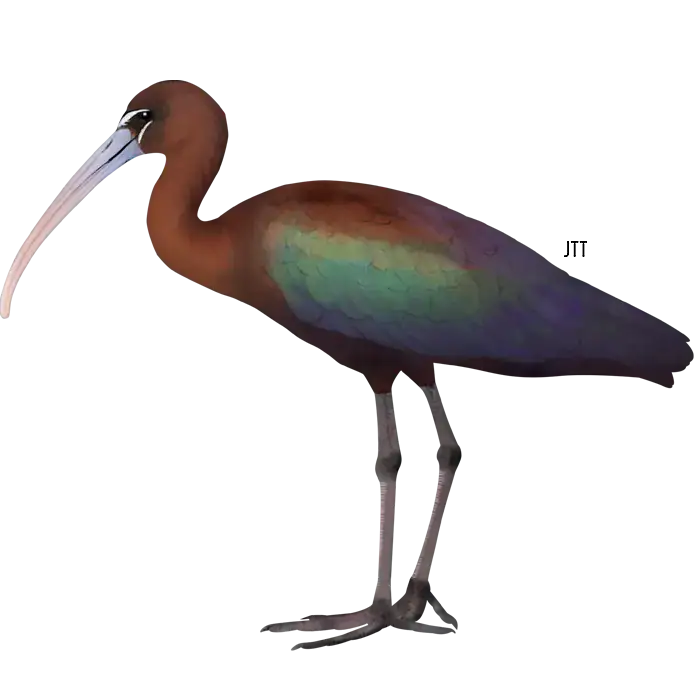
Glossy Ibis
Scientific name: Plegadis falcinellus
Habitat: Marshes
Frequency: Present year-round, more frequent from September to March.
Probability: High
ID notes: Medium-sized; long legs; long neck; long, slender and decurved bill; seems uniformly dark or black from a distance; breeding adults present rich chestnut head, neck, and underparts; metallic green-purple wings and back; legs are dull green-brown with pinkish tones on joints; non-breeding adults have duller body, with head and neck finely streaked with white; juveniles have brown head and neck, with a less iridescent (“oily” green) sheen, often with white streaks on the throat and neck; flies with neck outstretched and legs trailing; often in straight-line or V-formation.

Eurasian Oystercatcher
Scientific name: Haematopus ostralegus
Habitat: Shorelines
Frequency: Wintering
Probability: Medium
ID notes: Large body; glossy black-and-white plumage; pink legs; bright orange-red beak; red eye with a red ring around it; in winter, have a white half-collar across the throat; in summer the throat is all black; in flight, they show a broad white bar on each wing and a white rump that extends up the back in a narrow V; they’re noisy birds with a loud piping call.

Osprey
Scientific name: Pandion haliaetus
Habitat: Shorelines
Frequency: Migratory and winter visitor, mainly observed from September to April.
Probability: Medium
ID notes: Distinctively shaped hawk; slender body; long and narrow wings; long legs; brown above and white below; from below, wings are mostly white with a prominent dark patch at the wrists; white head with a broad brown stripe through the eye; juveniles have white spots on the back and buffy shading on the breast; fly with a marked kink in their wings, making an M-shape when seen from below.

Black-winged Stilt
Scientific name: Himantopus himantopus
Habitat: Wetlands (salt marshes, lagoons and rice fields)
Frequency: Resident
Probability: High
ID notes: Slender body; extremely long legs; striking black-and-white plumage; thin needle-like black bill; bright pink to red-pink legs; primarily white underparts; white head and neck; jet-black wings and back; breeding males have glossy black back and a more extensive black cap on the head; females have a browner, duller back that contrasts with the black wings, and less black on the head; juveniles have grey-brown upperparts with pale, sandy-buff fringes and duller yellow-pink legs; in flight, legs extend far behind the tail (up to 20 cm).

Black-tailed Godwit
Scientific name: Limosa limosa
Habitat: Wetlands (rice fields, estuaries)
Frequency: Transient migrant and winter visitor, mostly in January and February.
Probability: High
ID notes: Large body; long dark legs; long beak is orange or pink at the base and darker at the tip; in summer the head, neck and breast are orange; the breast has some dark barring that extends down onto the whiter belly; males have black feathers on their back, edged with orange, brown, mixed with some grey-brown feathers; females have more of the grey-brown feathers; juveniles have a buff wash to the neck and breast; in winter, the plumage is grey-brown; in flight, shows a white square on the rump with a thick black band across the tail, and a white bar across each wing, with the feet sticking out a long way past the tail tip.

Collared Pratincole
Scientific name: Glareola pratincola
Habitat: Shorelines
Frequency: Migratory and summer visitor
Probability: Medium
ID notes: Medium-sized; swallow-like appearance; long pointed wings; deeply forked tail; short legs; short, black-tipped bill with red at the base; highly agile and erratic, often feeding on the wing, similar to a swallow or tern; warm grey-brown upperparts; white belly; buff throat surrounded by a distinct thin black “necklace”; juveniles have grayer plumage, with scaly, white-fringed feathers on the back and a streaked throat lacking the prominent black collar; vocalizations similar to people’s laughter.

Common Sandpiper
Scientific name: Actitis hypoleucos
Habitat: Shorelines
Frequency: Resident and wintering
Probability: High
ID notes: Small body; clean white patch on the shoulder; thin eye ring; short green legs; short, straight, and bicolored beak; breeding adults are green-brown upperparts, white underparts and dark streaked breast patches; non-breeding adults and juveniles have olive-brown upperparts, but the young have more prominent buff tips on their feathers; constantly bobs its tail and head (“teetering”); in flight, low-level with rapid, stiff, bowed wingbeats, often alternating with short glides over water.

Common Snipe
Scientific name: Gallinago gallinago
Habitat: Wetlands
Frequency: Migratory and winter visitor
Probability: Low
ID notes: Medium-sized body; short legs; very long, straight and dark beak; mottled brown above, with paler buff stripes on the back; strikingly striped head with a dark crown, a pale central longitudinal streak; dark eye-stripe; short, barred buff and black tail; pointed wings with thin white trailing edge; in flight, distinctive zig-zag pattern; emits a sharp, rasping “creech” sound upon taking flight.

Eurasian Whimbrel
Scientific name: Numenius phaeopus
Habitat: Shorelines
Frequency: Migrants mainly observed in April-May and September-October.
Probability: High
ID notes: Brown plumage with mottled or streaked feathers on the back, breast, and neck; long curving dark beak giving a hook-tipped appearance; head pattern with dark crown with a distinct pale stripe running down the center of it, and a dark stripe through the eye; long, pointed wings with heavy, dark bar-like patterns on the underwing; in flight, have slightly darker wings and a more V-shaped white wedge; distinctive flight call, which is a rippling series of whistles.

Great Egret
Scientific name: Ardea alba
Habitat: Wetlands (rice fields / marshes)
Frequency: Summer.
Probability: Medium
ID notes: Large and slender body; all-white heron; long, yellow, dagger-like bill; long black legs and feet; long neck usually held in a characteristic S-shape; breeding adults have long ornamental feathers that grow on the back, and the bill turns partially or totally black-orange; flies with its long neck tucked in and its long legs trailing behind.

Grey Heron
Scientific name: Ardea cinerea
Habitat: Marshes / shorelines
Frequency: Resident
Probability: High
ID notes: Large body; grey, white, and black plumage; brown-yellow legs; long pale grey to whitish neck with broken black streaks running down the center; dagger-like yellow bill; white head with a broad black eyebrow stripe extending from above the eye to the back of the head, forming a crest; in flight, easily recognized by slow, deliberate wingbeats, with the neck retracted into an S-shape and legs trailing behind; breeding adults with deep orange-red bill; juveniles are duller grey, lacking the prominent head crest and black neck streaks of the adult, with a darker grey-yellow bill.

Kentish Plover
Scientific name: Charadrius alexandrinus
Habitat: Shorelines
Frequency: Resident
Probability: High
ID notes: Small body; “broken” black breast band; dark legs; slender black bill; breeding males feature a distinct black forehead band, black patches on the sides of the breast (not a full collar), dark ear coverts, and a rust-colored (rufous) patch on the rear of the crown-nape; females and non-breeding adults lack the strong black markings and rufous crown, though they retain the “broken” breast band, which often appears brownish; in flight, displays a prominent white bar on wings, white belly, and white outer tail feathers.

Little Egret
Scientific name: Egretta garzetta
Habitat: Estuaries / shorelines / rice fields
Frequency: Common resident, most abundant in winter (migratory / wintering bird)
Probability: High
ID notes: Small, elegant white heron; yellow feet; black legs; black, slender and dagger-like bill; breeding adults develop two long, thin plumes on the back of the head, along with lacy plumes on the back and chest; base of the bill and the facial skin may turn red; juveniles have greenish-black legs and duller yellow feet.

Purple Heron
Scientific name: Ardea purpurea
Habitat: Marshes
Frequency: Migratory and summer visitor. From March to September.
Probability: Medium
ID notes: Large and slender body; distinctively dark, rusty-red, or “purple-tinged” appearance; slate-grey back and wings; a red-brown breast; black belly; chestnut head and neck with a black stripe running from behind the eye down the side of the neck; adults possess a black crown and a short, dark, drooping crest; long, straight and yellow bill; pale yellow eyes; brown legs with long toes; juveniles are much paler, largely brown, lacking the distinct black stripes on the neck and the dark head markings; in flight, pronounced snake-like S-shape to their neck and slow wingbeat.

Ruff
Scientific name: Calidris pugnax
Habitat: Wetlands (estuaries, rice fields)
Frequency: Transient migrant. March, April, August and September.
Probability: Medium
ID notes: Medium-sized body; short, drooped, dark or orange beak; green to bright orange legs; breeding males have fancy neck ruffs that can be black, white, buffy, red-brown and have bigger bodies; females and non-breeding birds can be confusing, usually plain grey-brown with blotchy markings on the neck and belly; juveniles are bright buffy with neat scaly patterning on the upperparts; in flight are lazy or with deep floppy wingbeats and display white underwings, white sides to rump, and feet projecting well past tail.

Common Redshank
Scientific name: Tringa totanus
Habitat: Marshes
Frequency: Transient migrant and winter visitor. From August to April.
Probability: High
ID notes: Large body; long green-yellow legs; long neck; thick-based beak that curves upwards and is dark at the tip but green at the base; in winter they are very pale, with white underparts, a grey back and grey streaking on the crown and hind neck; in summer they have dark streaking on the breast and chevron markings on the flanks, and the back becomes a mix of grey feathers and black feathers with white fringes; in flight they show a white V on the back, merging with a white tail with dark barring; often reveal themselves with a loud “tyu-tyu-tyu” call.

Ruddy Turnstone
Scientific name: Arenaria interpres
Habitat: Shorelines
Frequency: Transient migrant and winter visitor
Probability: High
ID notes: Short, stocky, and oval-shaped body; stout and slightly upturned bill; orange legs; breeding males have unique black-and-white markings on the head and throat and a chestnut and black variegated pattern on the back; breeding females are paler than males; non-breeding adults have brown ghosting of the breeding plumage pattern; juveniles look like non-breeding birds but have rusty edges to the feathers; in flight, show a unique color pattern: white stripe down the back, black tail stripe, white rump, and white stripe down the wings.

Biologists’ Notes
As a responsible nature-lead boat activity, we want to lead you as close as possible to several aquatic bird species, but not to close to frighten them away.
Observation Success: It is important to conduct birdwatching activities with experts. Birdwatching tends to be richer when it’s done with people who know how to read a landscape. We provide binoculars, field support and local ecological knowledge, but what really makes a difference is learning to observe the small things: how birds react to the tide, why one mudflat suddenly fills with life, or why a flock lifts all at once and settles somewhere else.
Because this is a wildlife experience, sightings can never be promised. What we can offer is time in the estuary with people who know it well and who can help turn each observation into something more meaningful.
Patience matters here. Sometimes the estuary feels quiet at first, and then, almost without warning, it opens up.
Protection and conservation: The Tagus Estuary is legally recognised as a place of major ecological relevance. Portugal is part of the European framework for nature conservation, including the Birds Directive (2009/147/EC) and the Habitats Directive (92/43/EEC), which establish frameworks for the protection of species and habitats, including marine habitats and Natura 2000 areas.
How We Identify Them
Identifying aquatic birds in an estuary means paying attention to a mixture of features rather than relying on one single detail. Light, distance, tide and behaviour all influence what we can see, so we usually combine clues from structure, movement, habitat and plumage.
Note: Identification is not always possible. Some birds are distant, in moult, or seen only briefly as they move with the tide.
Science Deep‑Dive on the ecology of the group in the region of Lisbon
The Tagus Estuary is one of the most important wetlands in Europe and a key site for waterbirds along the East Atlantic Flyway. Its ecological-related importance comes from the way freshwater from the river meets saltwater from the Atlantic, creating nutrient-rich conditions that sustain worms, crustaceans, molluscs, insects, fish and plant life. This large amount of food is one of the main reasons that supports thousands of birds throughout the year.
Just as important is the variety of habitats packed into one landscape. Mudflats, salt marshes, shallow lagoons, tidal creeks and wetland edges create a shifting pattern of feeding and resting areas. For migratory birds, these places are not simply convenient. They are essential. They allow birds to rebuild energy reserves through long journeys between breeding and wintering grounds.
Feeding and hunting strategies
Aquatic birds of the estuary do not all feed in the same way. In fact, one of the most fascinating things about birdwatching here is seeing how different species reduce competition by using different bill shapes, body sizes and techniques.
Some species, such as godwits and snipes, probe deep into soft mud for worms and buried invertebrates. Others, such as plovers, rely more on surface pecking to visually spot prey in the sediment. Avocets sweep their upturned bills through shallow water, while spoonbills move their bills from side to side to detect small aquatic prey by touch. Herons and egrets are visual hunters, often standing still before striking fish or crustaceans with sudden precision.
This partitioning of feeding space and techniques helps many species use the same estuary simultaneously.
Ecological role
Aquatic birds are important mid- and upper-level consumers in the wider food web. They help regulate populations of invertebrates, small fish, and other prey, and their presence provides valuable information about habitat quality.
When bird numbers fall sharply, it can indicate changes in mudflat condition, water quality, prey abundance or disturbance levels.
In this sense, birds are not only beautiful to watch – they are ecological indicators.
Reproduction and life cycle
Many estuarine birds seen in Lisbon do not breed here, but use the Tagus Estuary as a wintering or stopover site. Others, including some stilts, avocets, herons and pratincoles, may breed in suitable wetland areas nearby.
Waders are often ground-nesting birds that lay their eggs in open habitats where camouflage matters more than shelter. Their chicks are usually precocial, meaning they leave the nest quickly and begin feeding soon after hatching. Many species are long-lived and show strong site fidelity, returning to the same migration and wintering areas year after year.
Behaviours that can be observed
The estuary is full of behaviour for patient observers: coordinated flocking, alarm calls, courtship displays, territorial disputes, resting at high tide, intense feeding at low tide and seasonal movements linked to migration. Some birds form dense mixed flocks, while others remain solitary and highly territorial.
One of the most dynamic moments is the shift in bird distribution with the tide. As feeding grounds disappear underwater, birds move to roosting areas, saving energy until the mud is exposed again.
Threats and conservation in the Lisbon region
Aquatic birds in the Tagus Estuary depend on the quality and stability of wetlands, mudflats and salt marshes. When these habitats are degraded, fragmented or disturbed, birds lose access to feeding and resting areas that are vital during migration and winter.
Important pressures include habitat loss, urban and industrial development, disturbance from human activity, pollution, climate change, and reduced prey availability. Disturbance is especially relevant in estuaries because birds must balance energy intake with safety. If they are repeatedly forced to fly, rest less or abandon feeding sites, their survival plus migratory success may decline.
Because the Tagus Estuary is part of a wider migratory network, local habitat damage can have international consequences. Protecting this estuary means protecting a much larger ecological route that connects Europe and Africa.
What helps – simple and educational actions
- Respect feeding and resting areas, especially during low tide and migration periods.
- Keep a responsible distance from birds and avoid flushing flocks.
- Support wetland conservation and habitat restoration.
- Report injured wildlife to the appropriate authorities or specialised organisations.
- Promote environmental education and awareness about estuarine biodiversity.
- Encourage good planning and responsible human use of protected natural areas.
Our Boat Tours
Our Boat Tours were carefully designed to offer the best nature and cultural experiences in the city.

Birdwatching Boat Tour

Dolphin Watching Boat Tour
Frequent Questions about Aquatic Birds
What is the smallest aquatic bird in the Lisbon region?
One of the smallest water-associated birds in the region is the Little Grebe (Tachybaptus ruficollis). It is small, compact and easy to miss at first, often sitting low on the water or slipping quietly into cover.
What is the biggest aquatic bird in the Tagus Estuary?
Among the largest aquatic birds regularly seen in the estuary are the Greater Flamingo, Grey Heron, Purple Heron and White Stork. Flamingos are especially striking because of their height and the size of their flocks.
Why is low tide so important for birdwatching in the estuary?
Low tide exposes mudflats rich in worms, crustaceans and molluscs. This is when many waders and other aquatic birds spread out to feed, making behaviour easier to observe and species easier to compare.
Are estuary birds competitive with each other?
Yes. Many species compete for food and safe feeding space, especially in winter when bird numbers are high. However, they reduce direct competition by using different feeding techniques, prey types and water depths.
Why is every birdwatching tour different, even in the same month?
Because the estuary changes constantly. Tide height, wind, light, temperature, prey availability and bird movements all influence what we see. Animal watching is dynamic by nature, which is exactly what makes it so engaging.
Lots of new birds!
My partner and I booked this tour so we could see as many birds as possible while we’re in Lisbon and we were not disappointed! Plenty of gulls, spoonbills, egrets, wading birds like pied avocets, black-winged stilts, and redshanks, and even some raptors like marsh harriers and a black kite gathering nesting material, almost all of which were new for our life list. Our guide was excellent and even though we were there for birds we appreciated the extra natural history information about the aquatic animals in the estuary and the landscape. If you’re a birder visiting Lisbon this is definitely the tour to take.
Fern
Tripadvisor
Mini Glossary of Specific Terms
Probing
Feeding technique in which the bird uses a long, slender beak or bill to search for food, like worms and insects, deep in mud, soft ground, or flowers, with examples including shorebirds (sandpipers, curlews) and some nectar-eaters (sunbirds).
Surface pecking
Foraging behaviour used to pick up seeds, insects, or grit from flat, hard surfaces.
Polyandry
A pattern of mating in which a female animal has more than one male mate.
Bobbing Walk
The natural up-and-down motion of walking. Birds famously bob their heads for stable vision.
Scientific References
This guide is supported by scientific literature, field research, and the SeaEO team’s know-how. Below you can explore the main sources used.
Appleton, Graham. 2018 “Waders are Long-lived Birds.” WaderTales. Accessed on: January 21, 2026
Assírio & Alvim. Guia de aves. Porto: Assírio & Alvim, 2022. 448 p. (Coleção Rosa-dos-Ventos)
Câmara Municipal de Lisboa. (2002). Estuário do Tejo: onde o rio encontra o mar. Edições Afrontamento. Accessed on: January 21, 2026
Cornell Lab of Ornythology. “Cornell Lab: All ABout Birds”. Cornell Univesity. Accessed on: January 19, 2026
Kalaiselvan (S). 2021. “Feeding Ecology of Waders Utilizing the Coastal Area: A Literature Review.” ResearchGate. Accessed on: January 21, 2026
Meirinho, A. et al. (2014/2015). Atlas das Aves Marinhas de Portugal. Sociedade portuguesa para o Estudo das Aves (SPEA). Accessed on: January 19, 2026
West, A. D., Goss-Custard, J. D., dit Durell, S. E. A. L. V., & Stillman, R. A. (2005). Maintaining estuary quality for shorebirds: Towards simple guidelines. Biological Conservation, 123(2), 211-224. doi.org
The Wildlife Trust (s.p.) “How to identifiy Waders” (online). Accessed on: January 21, 2026